Importance of Free Play in Preschool: How Children Learn While Having Fun
When parents think of preschool, they often picture worksheets, writing practice, and formal learning. But for young children, one of the most powerful teachers is something very simple: free play.
At Time Kids Preschool Anna Nagar, we believe that children learn best when they are happy, curious, and actively engaged. That’s why free play time in preschool is not “extra” — it is a planned and important part of our day.
Understanding the importance of free play in preschool is essential for fostering creativity and social skills in young learners.
What Is Free Play in Preschool?
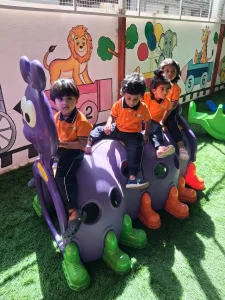
Free play is the time when children:
- ✅ Choose their own activities
- ✅ Decide whom to play with
- ✅ Use toys and materials in creative ways
- ✅ Explore at their own pace, with gentle guidance from teachers
This could be building with blocks, pretend play in the kitchen corner, puzzles, cars and tracks, dolls, clay, books, or simple floor games. It looks like “just play”, but so much learning is happening inside those little minds.
6 Free Play Supports Emotional Growth and Confidence
One key importance of free play in preschool is how it develops social skills. During free play, children:
- ✅ Learn to share toys and take turns
- ✅ Negotiate rules for simple games
- ✅ Solve small disagreements (“I had it first”, “Let’s both use it”)
- ✅ Choose friends and build bonds naturally
Instead of adults telling them what to do all the time, children practice real-life social situations in a safe, supervised environment. These early experiences help them become kind, confident, and cooperative.
When children are deeply involved in play, they talk more — to themselves, to friends, and to teachers. In free play, you will often hear:
- ✅ “Let’s make a big tower!”
- ✅ “I am the doctor, you are the patient.”
- ✅ “This is my shop. What do you want to buy?”
Through these simple conversations, children:
- ✅ Learn new words
- ✅ Practice making sentences
- ✅ Learn how to ask, answer, request, and refuse politely
- ✅ Gain confidence to speak in front of others
This learning through play in preschool builds a strong base for reading, writing, and classroom participation later.
Free play is like a gym for the brain. Children naturally experiment with ideas such as:
- ✅ Balance and stability while stacking blocks
- ✅ Size and shape while fitting puzzle pieces
- ✅ Counting and sorting while arranging toys
- ✅ Cause and effect while pouring, filling, and emptying
They ask themselves silent questions:
“Why did it fall?” “What if I try this?” “How can I fix it?” This kind of self-directed problem-solving strengthens:
- ✅ Concentration
- ✅ Memory
- ✅ Logical thinking
- ✅ Decision-making
All of these are key school-readiness skills.
Many free play activities involve movement:
- ✅ Pushing cars, carrying blocks, setting up tracks
- ✅ Pretend cooking, feeding dolls, setting up a “home”
- ✅ Building, jumping, crawling, running (in outdoor play)
These actions:
- ✅ Improve fine motor skills (small hand and finger movements needed for writing, buttoning, holding a pencil)
- ✅ Develop gross motor skills (big movements needed for running, jumping, balancing)
- ✅ Build stamina, coordination, and body awareness
So when children are busy “playing”, they are also building the physical strength they need for everyday tasks.
In free play time in preschool, there is no single “right” way to use toys. A block can be a car, a phone, a cake, or a building — depending on the child’s imagination.
Through pretend play and open-ended materials, children:
- ✅ Create their own stories and roles
- ✅ Try out real-life situations (doctor, shopkeeper, parent, teacher)
- ✅ Express ideas and feelings they may not yet have words for
This creativity helps children think in flexible ways, which is important for problem-solving and future learning.
Play is also a natural way for children to process feelings. During free play, they:
- ✅ Act out happy moments, worries, or fears using dolls and toys
- ✅ Feel a sense of control because they are choosing what to do
- ✅ Experience success when they complete a puzzle or build something big
With gentle encouragement from teachers, children:
- ✅ Learn to handle frustration (when a tower falls)
- ✅ Gain confidence (“I did it myself!”)
- ✅ Feel proud of their ideas and creations
This emotional strength helps them face new situations more bravely.
How We Plan Free Play at Time Kids Preschool Anna Nagar
At Time Kids Preschools Anna Nagar, free play is not random. It is thoughtfully organized with different learning corners such as:
- Block and construction corner – for problem-solving and motor skills
- Pretend play corner – for social, language, and emotional development
- Reading and book corner – for quiet time, listening, and imagination
- Art and creative corner – for drawing, coloring, sticking, and craft
- Fine motor activities – puzzles, beads, peg boards, and more
Teachers observe, guide, and extend play by:
- ✅ Adding new vocabulary
- ✅ Asking open-ended questions (“What will happen if…?”)
- ✅ Encouraging children to try different roles and ideas
For parents searching for a preschool in Anna Nagar or play school in Anna Nagar that balances structured learning with meaningful play, our approach ensures children get the best of both worlds.
Many early childhood experts also highlight the importance of play for brain and social development. UNICEF explains how play supports learning and well-being in early childhood.
How Parents Can Support Free Play at Home
You don’t need expensive toys to support learning through play in preschool and at home. You can:
- ✅ Offer simple materials: blocks, containers, spoons, cups, boxes, crayons
- ✅ Give children time and space to play without too many instructions
- ✅ Join in sometimes, but let your child lead the game
- ✅ Limit screen time so there is more time for active, imaginative play
You can also ask questions like:
- “What are you building?”
- “Who is in your story?”
- “What should we add next?”
These conversations show your child that you value their ideas and creativity.
Frequently Asked Questions
- 1. Is free play just “time pass” or real learning?
Free play may look informal, but it is full of real learning. Children practice social, language, motor, and thinking skills in a natural way. It supports what they learn in Circle Time and other structured activities. - 2. How much free play time should preschoolers have?
While the exact duration may vary, preschoolers benefit from daily free play sessions, both indoors and outdoors. At Time Kids Preschools Anna Nagar, free play is built into the timetable in a balanced way along with Circle Time, stories, rhymes, and planned activities. - 3. What if my child only plays with one type of toy?
It’s normal for children to have favorites. Teachers gently encourage them to explore other corners and materials, offering new ideas and challenges. Over time, most children naturally widen their interests. - 4. Does free play mean there are no rules?
Free play happens within clear, simple classroom rules such as:
Use kind hands and words
Take turns and share
Keep toys safe and tidy
These boundaries help children enjoy freedom while learning responsibility.
The importance of free play in preschool cannot be overstated. It lays the foundation for holistic development and lifelong learning.
To know how we balance free play with structured learning in our Nursery, LKG and UKG programs, visit our Programs page