
Montessori School Enrichment Class
Empowering Independent LearnersThrough Montessori
Our Montessori Enrichment Class at our Montessori school in Chennai is a thoughtfully designed program that nurtures your child’s natural curiosity and desire to learn. Every afternoon, from 2:00 PM to 4:00 PM, children explore a peaceful, carefully prepared environment that feels like a second home after school.
our program is designed to support children’s overall development. From practical life activities like pouring and sorting, sensorimotor games to develop focus, and activities that support language and early math, every aspect of our program is designed to allow for children’s natural development – both academically and personally.
Designed for Ages 2.5 to 6
We warmly welcome children aged 2.5 to 6 years from across Chennai into this nurturing community.
A Strong Foundation for the Future
-
Focus in Practical Life, Sensorial, Early Math, and Language:
Your child will be provided with a strong foundation for skills needed for subsequent learners. -
Led by certified Montessori educators:
Our educators reflect respect, curiosity, and kindness. -
Promotes Focus, Responsibility, and Independence:
Every child is encouraged to work at their own pace and in their own time, making decisions with confidence. -
Calming, child-centered environment:
We create an amniotic, safe, and loving atmosphere for your littlest banks to explore, discover, and grow.
At our Montessori school in Chennai, we believe in honoring the uniqueness of every child and nurturing a lifelong love for learning. Join us to give your child the gift of freedom, focus, and self-reliance — the Montessori way. 💛

What We Offer
What Your Child Will Experience

Hands-On Montessori Materials
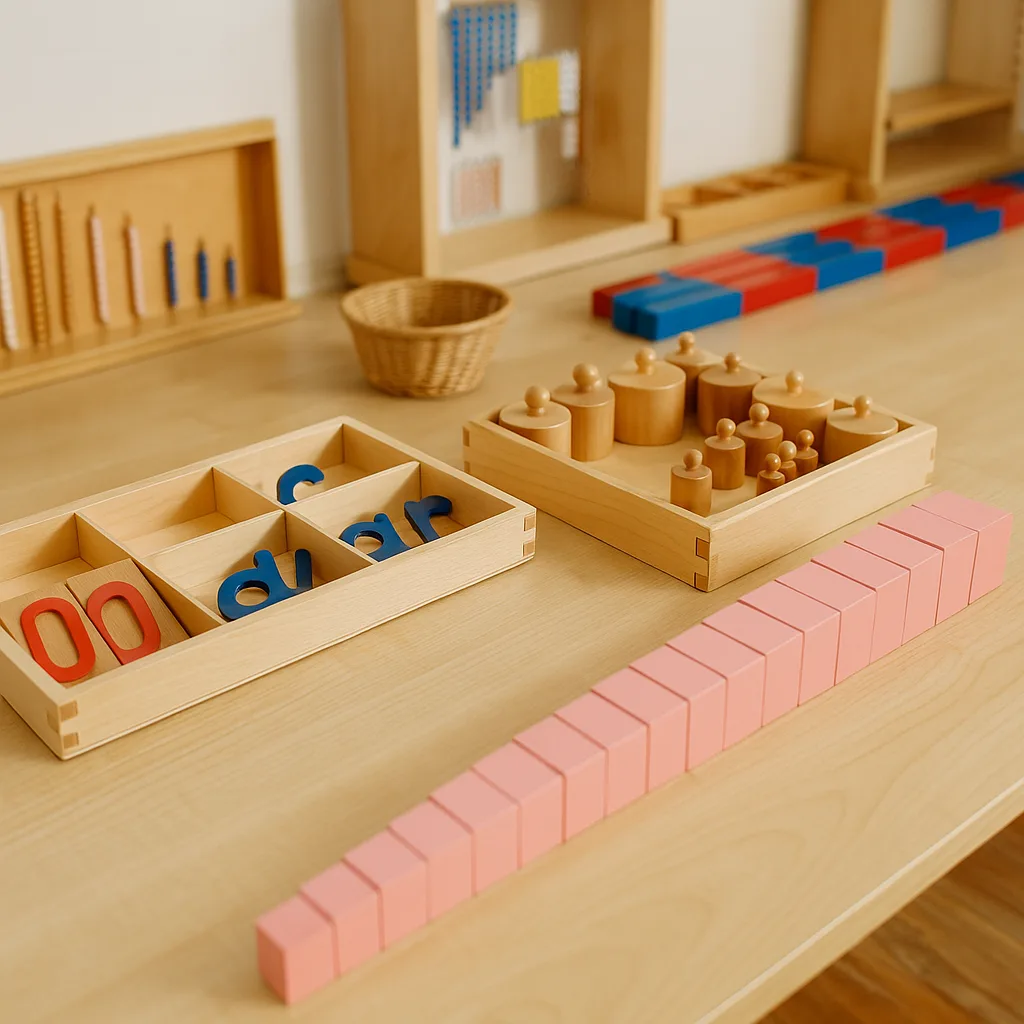
Your child will work with tactile, self-correcting tools that help them understand concepts like size, quantity, language, and order through discovery—not memorization.

Independence & Responsibility
From pouring water to tying shoelaces, daily activities build self-confidence, personal care, and respect for their surroundings.

Phonics-Based Language Learning
Children develop strong reading and writing foundations through phonetic awareness, sandpaper letters, and storytelling.

Concrete Foundations in Math
Montessori math materials help children understand numbers, patterns, and operations through beads, rods, and hands-on experiences.

Sensorial Exploration
Children refine their five senses using tools that isolate dimensions such as color, texture, sound, and weight—laying the groundwork for science and art

Grace, Courtesy & Social Growth
They learn to work independently and respectfully within a community—practicing patience, turn-taking, and empathy through everyday interactions.
Core Areas of Learning in Montessori
How Practical Life Skills Are Taught in Montessori School
✅ Child-Sized, Real Tools
At our Montessori school Chennai we offer our children genuine, child-sized tools – small glass bowls, wooden spoons, cloth napkins, buttons, and shoelaces. These opportunities produce responsibility, independence, and pride. Our practical life materials are selected to teach one property at a time – color, size, sound or texture, because we want to cultivate a productive space in which little hands can learn and grown.
Examples:
✅ Step-by-Step Demonstration
Montessori trained adults introduce new tasks slowly and silently. Each step is demonstrated clearly and gently so children are able to simply learn and absorb the process without worrying about the outcome first.
✅ Repetition Through Choice
Each new skill is introduced and the children are able to repeat the new skill as many times as they like. The freedom to be involved in all aspects of the process provides chances to develop muscle memory, self confidence, and deep concentration that lead to success in the early years.
✅ Built-In Control of Error
Every Montessori material has an inherent control of error – and when a child makes a mistake with their work, they are able to see and independently address their error! Through the hands on problem solving experience they develop independence, resilience, logical thinking and experimentation.
✅ Purpose Beyond the Task
While children may appear to be “just buttoning a frame” or “spooning rice,” they are developing:
Fine motor control
Left-to-right movement (pre-writing prep)
Concentration span
Order and sequencing
Respect for materials and surroundings
Why it Matters:
Every motion in Practical Life is purposeful and meaningful, laying the groundwork for concentration, order, and independence—key traits for lifelong success.
How We Teach Sensorial Development
✅ Intentionally Designed Materials for Each Sense
Children in our Montessori school use specially designed materials that isolate a quality, be it color, sound, texture or dimension.
In our classrooms, we use the following materials:
Pink Tower – develops a visual awareness of dimension and order
Sound Cylinders – develops an ear for auditory discrimination
Color Tablets – develops color awareness and visual discrimination
Touch Boards & Fabrics – develops a child’s connection to their tactile sense
Smelling Bottles – develops awareness of the olfactory sense
✅ Gradual Release of Responsibility
The Montessori guide (teacher) introduces each sensorial material in a slow and deliberate way, and after the child has watched the demonstration they can practice independently and absorb the knowledge through repetition.
✅ Comparing & Grading Senses
Children learn to sort, match and grade their comparisons through sound, weight, temperature, or touch. Grading these are all concrete experiences that develop their sensory perception skills and expand their abstraction when grasping a concept.
✅ Language Development
As children engage and explore concepts, they also develop their vocabulary by using descriptive words to identify the experience. Now they can describe the experience with words such as rough, smooth, heavy, light, loud, or soft, which makes the experience all the more interesting and meaningful.
✅ Building Future Learning Pathways
Sensorial work promotes better observation, attention to detail, and logical thought processes. These skills lend themselves to math, reading, writing, and science.
Why It Matters
Sensorial development is much more than hands-on fun — it is the foundation for focused attention, critical thinking, and organized thought. By engaging all the senses, our Montessori school in Chennai empowers children to explore, discover, and understand the world around them with confidence, creativity, and joy.
🗣️How Language Is Taught in Montessori
✅ Phonetic Awareness Comes First
Children are introduced to letter sounds (phonemes) before letter names. Using sandpaper letters, they trace and feel each shape while saying its sound—connecting movement, touch, and sound.
✅ Hands-On Reading Tools
With the Moveable Alphabet, children form words before they can write with a pencil. They build words phonetically, learning how sounds blend into meaning.
✅ Enriched Vocabulary & Object Lessons
Teachers introduce language through real objects, classified cards, and pictures—expanding vocabulary while teaching categories, attributes, and names.
✅ Storytelling & Conversation
Children engage in daily storytelling, puppet play, and role-play to build expressive language. Group discussions help them learn to listen, take turns, and share ideas clearly.
✅ Writing Comes Before Reading
Once children master sounds, they begin writing simple words using moveable letters and eventually with a pencil. Reading follows naturally as they recognize and understand familiar words.
Why It Works:
Montessori language education is multi-sensory, self-paced, and deeply connected to real-world experience, making it ideal for building lifelong communication skills
🔢How Mathematics Is Taught in Montessori
✅ Concrete Before Abstract
Children first work with real, physical objects—beads, rods, spindles—to understand number quantity, size, and relationships. They don’t just see the number 5—they can feel it, count it, and build it.
✅ Number Sense & Counting
Using tools like Number Rods, Sandpaper Numbers, and Spindle Boxes, children learn to recognize quantities and associate them with their written symbols (e.g., 1–10).
✅ Place Value & Decimal System
Golden Beads and Montessori cards introduce units, tens, hundreds, and thousands in a way children can build and break apart—making abstract math ideas visible and logical.
✅ Operations Made Visual
Children physically carry out addition, subtraction, multiplication, and division using bead chains, counters, and boards—seeing how numbers work, not just solving problems on paper.
✅ Sequencing, Patterns, and Logic
Math in Montessori also includes pattern recognition, classification, and estimation—boosting both cognitive development and early problem-solving skills.
Why It Matters:
Montessori math teaches understanding before memorization, so children become confident, curious, and capable learners—ready to tackle higher-level math with ease.
🗺️ How Cultural Subjects Are Taught in Montessori
🔬 Science
Children learn by observing, experimenting, and questioning the world around them. Topics include:
Living vs. non-living things
Life cycles of plants and animals
Human body, weather, and seasons
Simple, hands-on experiments (e.g., sink vs. float, magnetism)
Montessori science nurtures natural curiosity by letting children discover how things work through exploration.
🗺️ Geography
Children explore physical and cultural geography using globes, puzzle maps, and landform trays:
Continents, countries, flags, and landmarks
Land vs. water forms: island, lake, mountain, valley
Cultural traditions, food, clothing, music, and celebrations
Geography helps children understand their place in the world and appreciate its diversity.
🎨 Art
Art is integrated into daily work as a form of self-expression and creativity:
Drawing, painting, collage, clay, and craft
Introduction to famous artists and global art styles
Materials are freely available—no step-by-step rules, just exploration
Montessori art encourages freedom of expression while developing fine motor skills and visual thinking.
Why It Matters:
Cultural subjects in Montessori spark curiosity, global awareness, and creative expression—essential qualities for a thoughtful, well-rounded learner.
🌿 How Grace and Courtesy is Taught in Montessori
✅ Modeled by the Teacher
Montessori teachers demonstrate polite and respectful behavior through tone of voice, body language, and actions—modeling how to speak kindly, move gently, and treat others with care.
Children absorb these behaviors naturally through observation and gentle guidance.
✅ Role-Playing Lessons
Children are shown how to:
Greet a friend or adult politely
Say “please,” “thank you,” and “excuse me”
Offer help or accept help gracefully
Wait their turn or walk around others carefully
Handle classroom materials with care
These are taught in short, calm group lessons and practiced during the day.
✅ Opportunities to Practice Daily
Everyday routines—like working together, setting up for snack, or waiting in line—become moments to practice empathy, patience, and respect.
✅ Respect for Self, Others, and Environment
Children learn to:
Take responsibility for their work and belongings
Respect personal space and boundaries
Resolve conflicts peacefully
Care for plants, animals, and shared materials
✅ Non-Verbal Cues and Calm Communication
Children are also taught how to listen attentively, speak gently, and use non-verbal signals like placing a hand on a peer’s shoulder when they want attention.
Why It Matters:
Grace and Courtesy in Montessori isn’t just about manners—it’s about building a community rooted in mutual respect, compassion, and confidence.